Let us deal with the honest bit first, because it is the single most common criticism and it is entirely fair.
It is a reconstruction — and that is the point
Fire broke out in the Winter Riding Hall on 28 May 1811 and gutted the castle. It then stood as a roofless ruin for over 140 years, with the military selling off the stone. What you walk through today was rebuilt between 1953 and 1968, restored to the 18th-century Theresian palace.
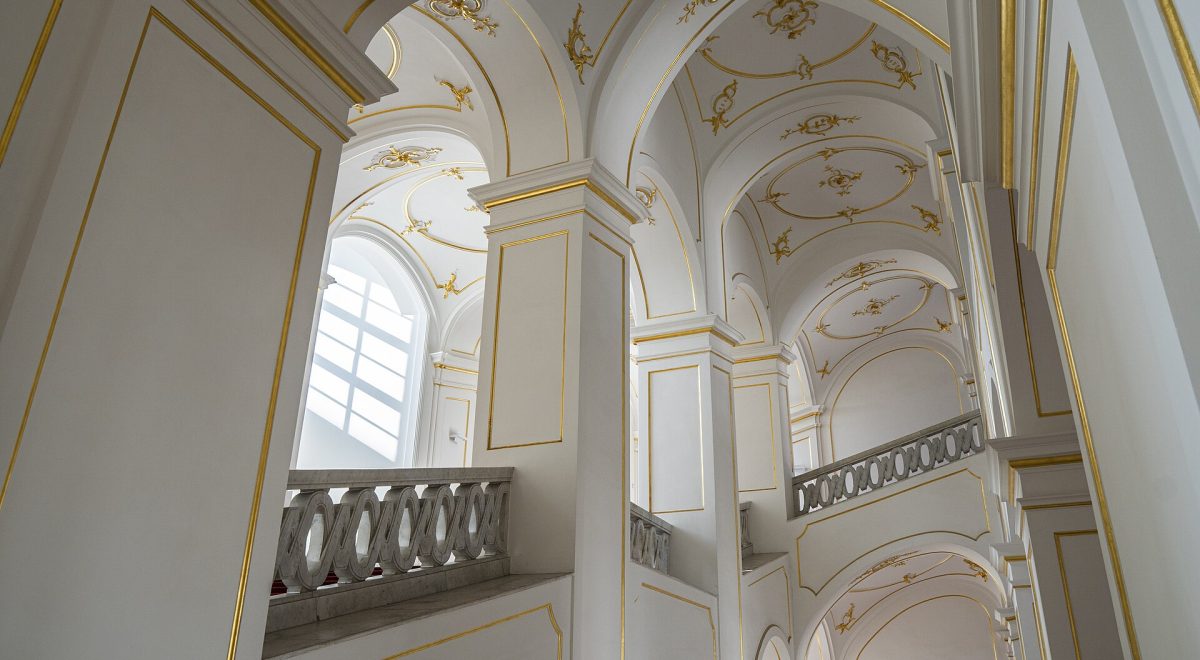
So the interiors are bright, modern and white rather than dark and medieval. Visitors who arrive expecting worn flagstones and suits of armour are disappointed; visitors who know they are seeing a careful recreation of a Habsburg-era residence, built on genuinely ancient foundations, tend to enjoy it a great deal.
The one genuinely medieval thing
The Crown Tower, on the south-west corner. It is 13th century, 47 metres tall, and the only building on the site still standing from the medieval castle. The other three corner towers — the ones that give the castle its famous “upturned table” silhouette — were not added until the 17th century, which makes the shape four hundred years younger than its oldest leg.
From 1552 until 1784 the coronation jewels of the Kingdom of Hungary were locked in that tower under permanent guard. Today it holds a faithful replica of the crown, coronation medals, and a viewing platform from which you can see into three countries.
What you see, floor by floor
- Basement — Celts from Bratislava, and the 15th-century cellars. The Celtic settlement here struck its own silver coins in the 1st century BC, and there is a Roman-built opus signinum mosaic floor preserved in place beneath the courtyard.
- Ground floor — the Treasury and the Crown Tower, the Northern State Rooms, and the Theresian honorary staircase, which the museum calls one of the largest interior Baroque staircases in Central Europe.
- First floor — state rooms, and the castle chapel.
- Second floor — temporary exhibitions, in what were once the apartments of Maria Theresa’s children. There is a medieval wall about 7 metres thick up here.
- Third floor — History of Slovakia, more temporary exhibitions, and the café and museum shop.
The stories worth knowing before you go
The Albertina started here. Albert of Saxe-Teschen was Royal Governor of Hungary from 1765 and lived in this castle. He founded his print collection in Pressburg in 1776 — the collection that, once moved to Vienna, became the Albertina.
The castle is in your pocket. It appears on the Slovak 10, 20 and 50 cent euro coins.
The Slovak Constitution was signed in the Knight’s Hall in 1992 — the same room that now holds the Marie Antoinette exhibition.
How long to allow
Ninety minutes to two hours for the castle route. Add another hour if you are also doing Marie Antoinette. Add more if the weather is good, because the terraces will keep you longer than you plan.